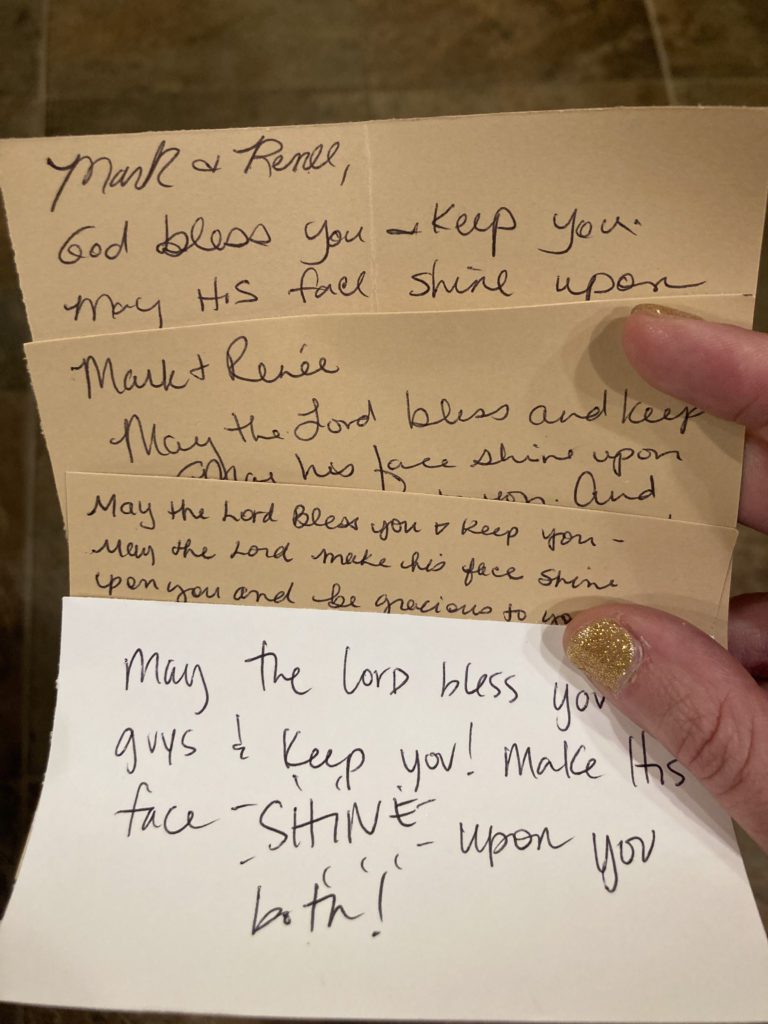
This summer Mark and I opened a glass jar that was sealed at our wedding reception: our guests wrote messages to us for our one-year anniversary, and we couldn’t wait to see what words 2020 inspired them to write. What we found was … mostly the same.
On note after note, Mark and I read Numbers 6:24-26 in different handwritings:
24 May the Lord bless you
and protect you.
25 May the Lord smile on you
and be gracious to you.
26 May the Lord show you his favor
and give you his peace. (NLT)
Not going to lie: As a writer who strives for fresh expressions, I was initially disappointed, having expected more personalized notes. But minutes before opening the jar, I’d read a Facebook post about the late theologian Thomas Oden who said his goal was not originality but faithfulness. If that was the goal of a theologian, why should I strive for less?
Humility settled over me: People were blessing us with one of the most beloved, time-tested prayers in the Bible, and I was fighting off dismay? The priestly, Aaronic blessing that was quoted daily in Israel, that centers on the presence of the Lord and uses His personal name, and I was hoping for something else?
The question of faithfulness or originality carried with me through summer and into the present. This summer showed us devastation in Afghanistan, a lingering pandemic, and terror at international borders, among other ongoing crises. As a writer, I feel the pressure for originality acutely and daily. Not just what to say but *how* to say it makes all the difference.
I face the dilemma of what to say and how to say it on a personal level, too: tonight, my mother-in-law remains in a hospital, several friends are facing seemingly unbeatable cancers, and obstacles to progress with certain life goals seem insurmountable. Do I search for an encouraging word they haven’t thought of? Do I dare speak oft-repeated phrases they can finish themselves?
We don’t always have to choose between faithfulness and originality, but when we do, let’s choose the first. When recycled words refer to the bedrock of belief, we’re better off clinging to them than jumping off into the less-true-but-sounds-good.
Don’t get me wrong: I endeavor to learn more about what my loved ones are facing — about uncontrolled cell growth and trauma response and mental health and daily injustices on personal and institutional levels — and I seek to be an agent of change. But if I seek to share only my latest findings while bypassing faith, hope, and love, I’m selling people short.
For my mother-in-law, I pray the priestly blessing tonight. For my friends with cancer, I speak out the truth of the Holy Spirit’s comfort from 2 Corinthians 1. For my own foibles, I bank on God’s promise to carry to completion what He started in me (Phil. 1:6).
Our opinions have more of a platform today than ever before, and you might be feeling the pressure of what to say about everything from peace in the Middle East to economic disparity to your best friend’s birthday party. I feel that pressure with you. And I encourage you, from my deepest conviction, that faithfulness over originality is worth it. What do you know that you know that you know? Remember that God so loved…and love wins. Remember that all injustice will one day bow before the feet of Jesus, slayed though innocent and rising impenetrably victorious over history’s vicious cycles of oppression. No matter how timeworn the truths…they’re still true.
If we died to being original, some good things would come to life.
.
.
P.S. The Oden quote came from an excellent post by professor Charlie Self about citing sources, so I must give him credit.